
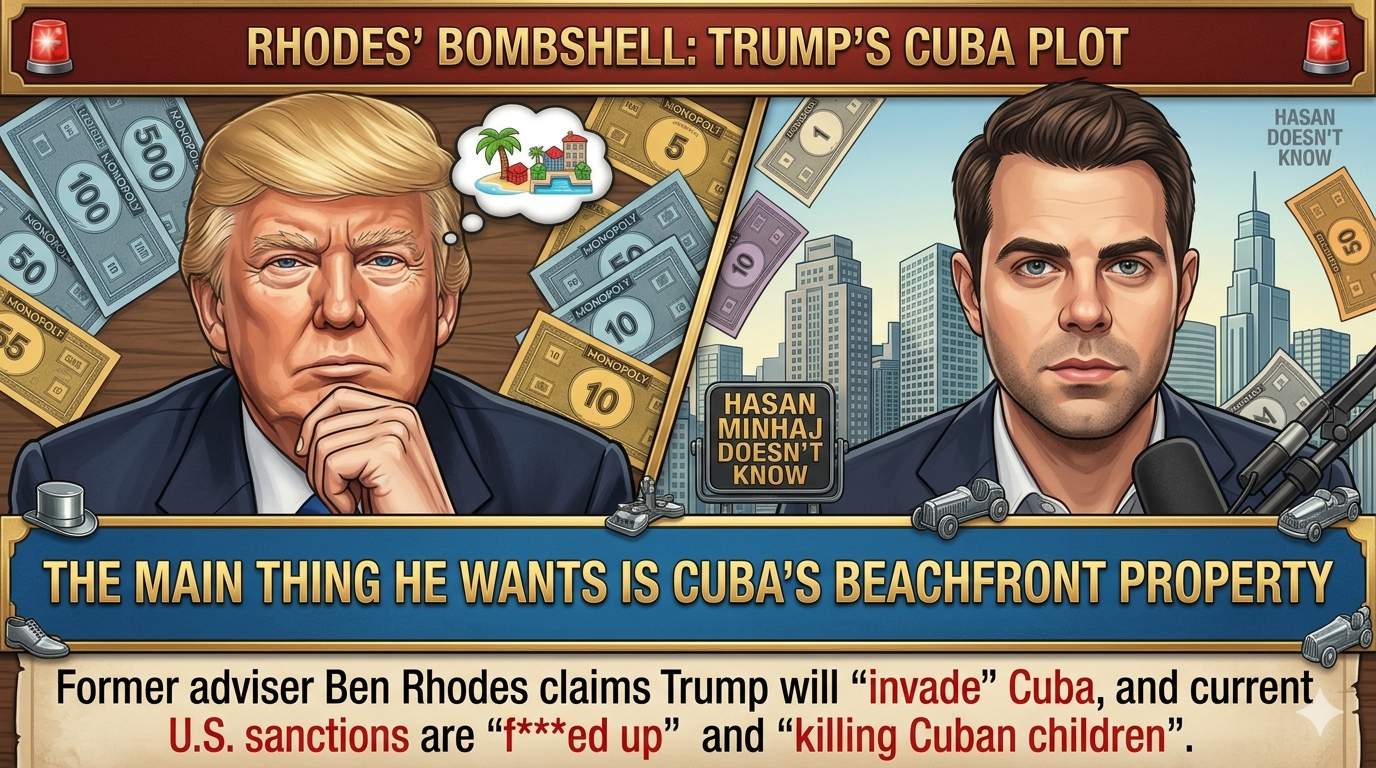
Ben Rhodes, the former deputy national security adviser who secretly negotiated normalization of relations with Cuba under the Obama administration, said he believes Donald Trump will order a military invasion of Cuba.
“He’ll do something,” Rhodes said in an interview with Hasan Minhaj, an actor, writer and political commentator.
Rhodes said Trump wants Cuba’s beachfront property.
“There’s, you know, dollar signs probably in these guys eyes,” he said.
Rhodes, who continues to advise Barack Obama on international strategy, blames U.S. sanctions against Cuba for “most” of the suffering going on in Cuba right now.
“…If you go to Cuba, it’s one of the poorest places you’ll ever go. They don’t choose to drive 1950s cars, right? They can’t buy fucking new cars because they have no capacity to access the dollar.
“…By keeping them hermetically sealed, we give them no choice but to be a controlled communist economy. And then we claim that the Communist Party is mismanaging it. The Communist Party would open up their economy tomorrow if they could. They were studying Vietnam when I was dealing with them. They wanted to be Vietnam.
“But it’s our fault. We are starving people to death right now.
“Now that we have a total oil blockade, the power shuts out in Cuba on some regularity. I’ve talked personally to people who are Cuban, Cuban-Americans who’ve had family members die because they were on a ventilator that turned off. If the power shuts off, the NICU (Neonatal Intensive Care Unit) shuts off, the ventilator shut off.
“Those same family members couldn’t even attend the funerals of the people who died because guess what? You can’t cool a body without power, either. That’s how dark it is.
“We, taxpayers, are supporting a policy that is killing Cuban children and old people because some people in Florida would like to take back that island.
“And that is about as fucked up as it gets.”
Below is a transcript of portions of the conversation that dealt with Cuba:
Ben Rhodes: So I negotiated the normalization. Yeah. I spent hundreds and hundreds of hours with Alejandro Castro, Raul’s son.
I had some very late nights with Raul Castro. Drank some very good Havana Club rum with Raul Castro and kind of culminates in this trip.
And first of all, that press conference was a concession, right? Raul Castro does not hold press conferences. And so what’s in it for us? What’s in it for us is, well, Raul Castro is to stand up there and have people raise hands and why are their political prisoners locked up? Why did you know? And so we were modeling, well, you open things up here and, you know, this is what can happen. What’s in it for Raul Castro is he wants that photo.
Like Barack Obama is hugely popular in Cuba. Right. And so he wants to like lift Obama’s arm in triumph.
Now, Obama, very respectful person, happy to shake Raul Castro’s hand. But you don’t want, you know, that photo. And so it kind of led to a fairly unfortunate-
Hasan Minhaj: Yeah. So Barack’s doing the jump shot. And Raul Castro wants to go full Narendra Modi. He wants to go full hand in hand. Let’s do it. Yeah.
Rhodes: And, you know, I mean, it didn’t look good for anybody involved, I guess, but it was better, I think, in the long run than.
Minhaj: Well, then what’s the meeting like with you guys afterwards? So you’re with the president and he’s with his team. It’s awkward on all counts here.
Rhodes: This is an important thing for because there are hardliners in this country who hate the Cuban government, too. So particularly Cuban-American community, Marco Rubio. And that’s a whole other conversation because, you know, we that’s the second AIPAC in American politics.
They don’t have as much money, but they do wield a lot of power. Cuban-Americans, the hardline Cuban-Americans, because they’re Cuban-Americans that supported what we did. A lot of them.
Just like they’re Jewish-Americans that don’t like AIPAC. But we were pushing farther than the Cuban government wanted. The criticism of us was like, you’re selling out.
Well, actually, no, like because I was there throughout that whole trip. I went there multiple times to set up that trip. So here’s what happens.
Obama goes down to Cuba. The entire international media comes. He meets with entrepreneurs, people that are not controlled by the Communist Party and are building small businesses.
He meets with dissidents. He gives a speech that we got aired on Cuban television, which he talks about in a very respectful way, not in a lecturing way, but he talks about democracy and the people of Cuba should be able to decide their future. So we’re pushing like way ahead of their comfort zone, you know.
In our view, we’re demonstrating that if you open things up, it’s more likely to bring choice to the Cuban people. I got an earful after that trip. What they were most upset about was not that picture.
It was Obama’s speech. Apparently, Fidel Castro personally hated that speech, was offended by that speech, thought Obama should not have been allowed to give that speech on television. I think Fidel had always been a skeptic.
This is another problem with American system. We think any adversarial government, particularly a closed government, is a monolith where everybody thinks the same way.
I think Fidel and Raul had different ideas. Raul was more pragmatic. He wanted to open things up to the United States.
Fidel wanted to die in his boots, you know, standing up the United States. And so part of what happened is after that trip, the Cubans kind of were like, oh, wait a second, we got to like rain in the sand a little bit, you know. But they couldn’t because things were opening up.
Americans are traveling down there. They’re staying in Airbnbs. Internet’s coming to Cuba.
The Rolling Stones are playing concerts like everybody wanted to go to Cuba. Then Trump comes in and he, you know, winds back the Obama opening, shuts the door on travel, shuts the door on. Why would you do that? Like if you actually want to change Cuba, wouldn’t you want as many people to be going there as possible? Sharing ideas, you know, and kind of hermetically sealing them once again in this, you know.
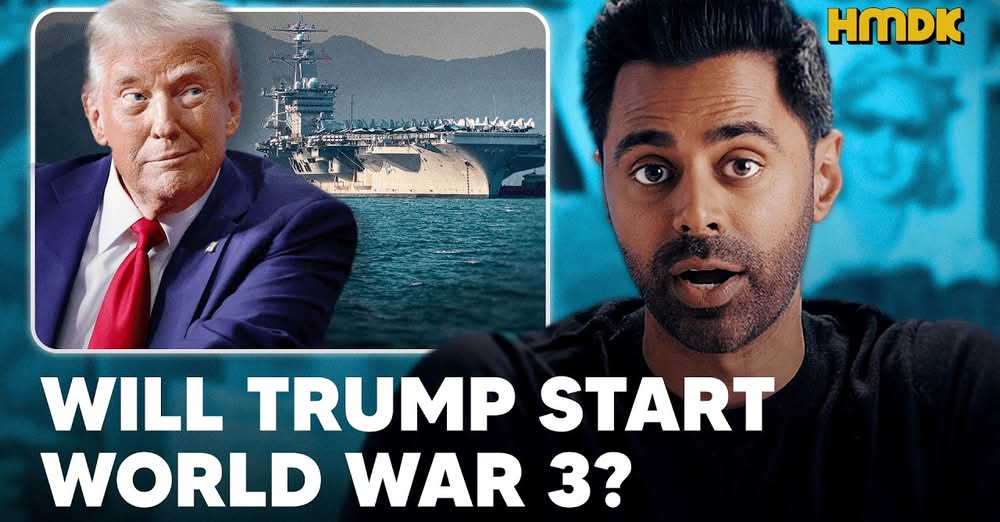
Minhaj: Well, now that Trump has closed things down, will the United States invade Cuba next?
Rhodes: I think so. They’ll do something.
Minhaj: But but there’s nothing to really steal there. So what are they going to steal? Like universal health care or what do they want to take from them?
Rhodes: Real estate. So Venezuela has oil. Cuba has a lot of beachfront property.
I mean, I mean this like when I was some of the same Cuban-Americans who talk about democracy wanted to, like, develop the Keys off the coast of the, you know, there’s beautiful. I’ve been there. There’s, you know, dollar signs probably in these guys’ eyes.
When I was talking to the Cubans in 2016 and I was starting to be like, hey, you know, are you worried about Trump? Like, no, no. The Trump organization sent people down here. They want to build golf courses down here.
So I think Marco Rubio wants to be the guy, the first guy who actually got it done, got regime change done in Cuba. I think Donald Trump is like, there’s a lot of real estate there. You know, that’s the oil.
Minhaj: Is this expansionist worldview really just about hotels?
Rhodes: Hotels and oil, you know, and and natural resources for like drone components and, you know, cell phones.
Minhaj: I’ve just never been able to wrap my head around that, that kind of the war to Marriott Bonvoy points pipeline. I just don’t get it.
Rhodes: Oil in Venezuela, real estate in Cuba, rare earth minerals in Greenland. There’s there’s a bonanza everywhere.
Minhaj: So the media narrative.
Rhodes: That’s what empire has always been about.
Minhaj: Well, well, let’s talk about the media narrative of the American empire. The media narrative around Cuba is always Cuba. Is this extremely poor, extremely depressing place to be? These people are poor. They are suffering. But how much of that suffering comes from America’s own actions?
Rhodes: I would say most of it. The media narrative doesn’t like to say that. They’re like, well, you know, the Cuban Communist Party, you know, it mismanages the economy. Here’s the thing. There’s been a total embargo on Cuba, and there’s been this thing where we designate them a state sponsor of terror. Are you aware of Cuba sponsoring a terrorist organization?
Minhaj: Not that I’m aware of.
Rhodes: So we remove them from that. The reason that’s important.
Minhaj: Is it still, is that is that still sticking around from 1962?
Rhodes: No, they got thrown on that sometime after the Cold War.
Minhaj: OK.
Rhodes: Because what that does, it cuts them off from the dollar. So the reason I say and by the way, just quick aside. When we remove them, I went to what is the justification that they’re on here? And somebody had found that they harbored a couple of Basques, you know.
Minhaj: B.A.S.Q.U.E.
Rhodes: Yes. Who committed acts of terrorism in Spain? I called the Spanish. They’re like, oh, yeah, we asked them, please take these people. We don’t want them here anymore. So they were doing a favor to our ally Spain and taking these guys. So we take them off the list. But still banks are so worried about getting crosshairs with the United States that like it was hard to get anybody to a dollar transaction.
Now, the reason this is important is if you go to Cuba, it’s one of the poorest places you’ll ever go. They don’t choose to drive 1950s cars, right? That’s the thing that people have in mind. They can’t buy fucking new cars because they have no capacity to access the dollar.
They can’t. I flew into the Havana airport. They wanted to build a new airport. They wanted the Europeans to build a new airport for them. But no European contractor would do it because they literally can’t facilitate the transaction. They started a private sector, the thing that we claim we want them to do. People own small businesses in Cuba without the government controlling them. Stores, taxis, restaurants. I went to a palador in Cuba with Jose Andres, you know, great food.
But they can’t open up their economy if there’s nothing to plug their economy into. And so by keeping them hermetically sealed, we give them no choice but to be a controlled communist economy. And then we claim that the Communist Party is mismanaging it. The Communist Party would open up their economy tomorrow if they could. They were studying Vietnam when I was dealing with them. They wanted to be Vietnam.
You know, I would bet, by the way, that they couldn’t maintain political control because Vietnam is not 90 miles from Florida. But it’s our fault. We are starving people to death right now.
Now that we have a total oil blockade, the power shuts out in Cuba on some regularity. I’ve talked personally to people who are Cuban, Cuban-Americans who’ve had family members die because they were on a ventilator that turned off. If the power shuts off, the NICU shuts off, the ventilator shut off.
Those same family members couldn’t even attend the funerals of the people who died because guess what? You can’t cool a body without power either. That’s how dark it is. So while we’re walking past, you know, Maduro in prison, we, taxpayers, are supporting a policy that is killing Cuban children and old people because some people in Florida would like to take back that island.
And that is about as fucked up as it gets.
Minhaj: Are you are you without saying it? Are you without naming names? Are you just basically saying Marco Rubio right now?
Rhodes: Oh, yeah. I mean, Rubio, Rubio and kind of the politics he comes out of. It’s it’s you know –
Minhaj: Is there any universe where he doesn’t end up invading Cuba, either a secretary of state or as future president of the United States?
Rhodes: I mean, no, I think what he would prefer, right, is like, can you send some CIA guys down there and do some sabotage? Can you do a special forces operation like Maduro? Now, the problem for them is then the Trump administration is that Cuba’s president, Diaz-Canel, is actually not really like in charge. He’s kind of a, you know, the the functionary who’s the front man for the system. So like going and arresting Diaz-Canel is not, nobody has heard of that guy in the United States. Right. Yeah. So then they’re like, well, maybe we’ll arrest Raul Castro.
Raul Castro is 93 years old. Going and arresting a 93 year old man with a bunch of Delta Force or Navy SEAL guys feels, you know, so they don’t have like a great military option.
Google’s Gemini rates this article as “highly accurate.” See fact check.