

On Jan. 29, President Donald Trump proclaimed that Cuba was “an unusual and extraordinary threat” to U.S. national security. He then moved to cut off oil supplies to the island, plunging the country into its worst economic crisis in decades.
Fairness & Accuracy in Reporting, or FAIR, examined coverage of the story by the Associated Press, the New York Times and the Miami Herald.
The wire service and the two newspapers published a total of 181 articles containing 862 quoted sources from January 1 to March 31, 2026.
FAIR concluded: “Where AP reporting—frequently from on the ground in Cuba—emphasized the experience of everyday Cubans, the Times and Herald elevated official voices, and gave those from the US far more room to speak than those from Cuba. The Herald also stood out for the platform it gave to Cubans living outside of Cuba, marginalizing the voices of those still on the island.”
The media watch group said the Miami Herald’s coverage heavily reflected its local demographics. Sources of Cuban descent made up 39% of its total sources. These sources heavily skewed toward anti-Cuban government positions, leaving the direct human suffering of the blockade on the island largely unexamined.
Across all three outlets, Republican officials overwhelmingly dominated the U.S. sources. AP was the only outlet to quote dissenting Democrats or international bodies like UN human rights experts.
The AP and the Times avoided anonymous sources entirely, but the Herald granted anonymity 30 times, accounting for 10% of its sources.
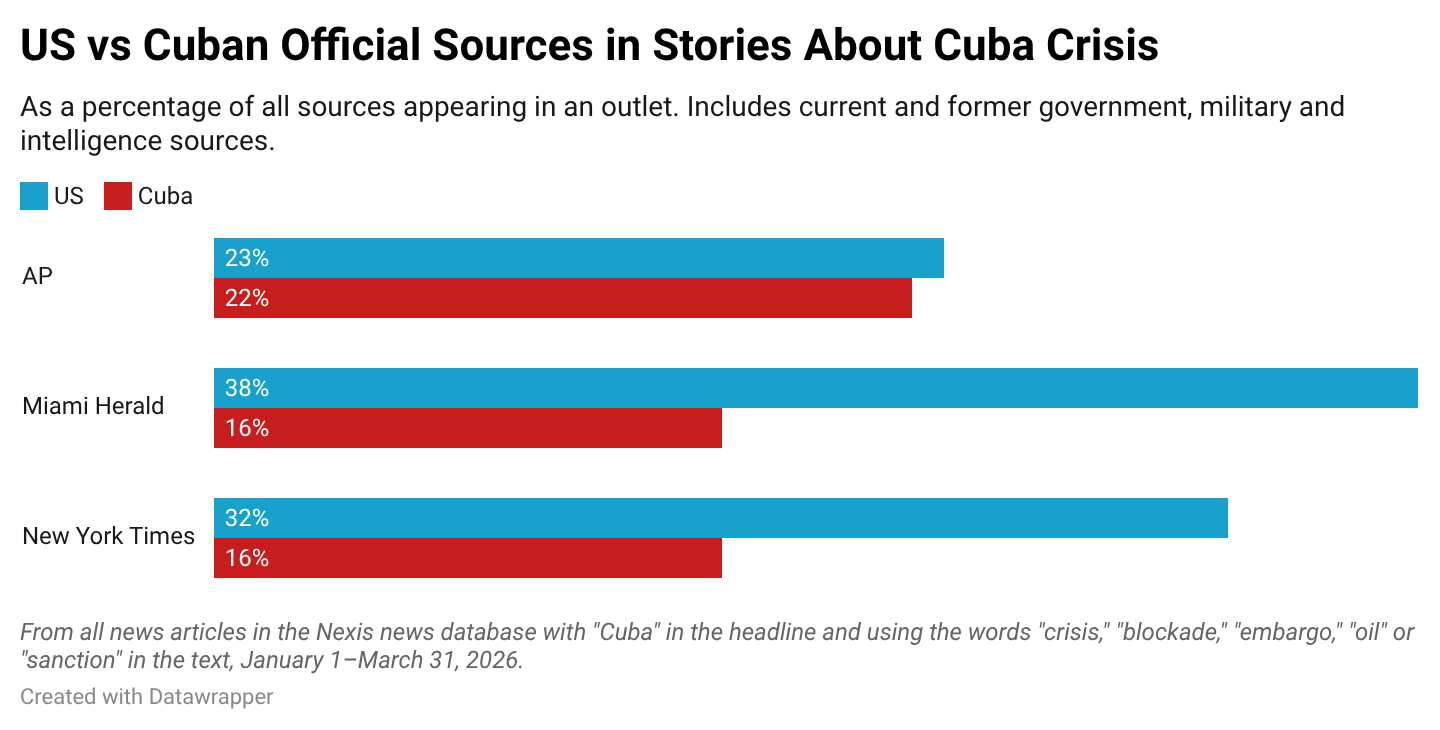
The Herald and the Times were much more likely to quote U.S. sources than Cuban government sources.
“When an outlet publishes far more quotes from US officials, then, that means far less criticism of the blockade,” FAIR said. “Only AP made an effort to offer balance between the two governments.”
“On the rare occasions that the Herald published quotes about the humanitarian situation, it typically looked to critics of the Cuban rather than US government…”
Most of the ordinary people quoted by the Herald – 88% – were people in the U.S. with Cuban backgrounds.
So when the Herald runs a headline like March 13’s “What People Are Saying as Talks Continue Between the U.S. and Cuba,” what it actually means is “What Cubans in the US are Saying.”
What do you think? Is U.S. media coverage of Cuba biased?
Fact check: Google’s AI tool, Gemini, rates this article as accurate. See report.
1 thought on “Study shows pro-U.S. bias in Cuba reporting”