
On March 19, Gen. Francis Donovan, commander of U.S. Southern Command, sat before the Senate Armed Services Committee and declared, “The U.S. military is not rehearsing for an invasion of Cuba or actively preparing to militarily take over the island…”
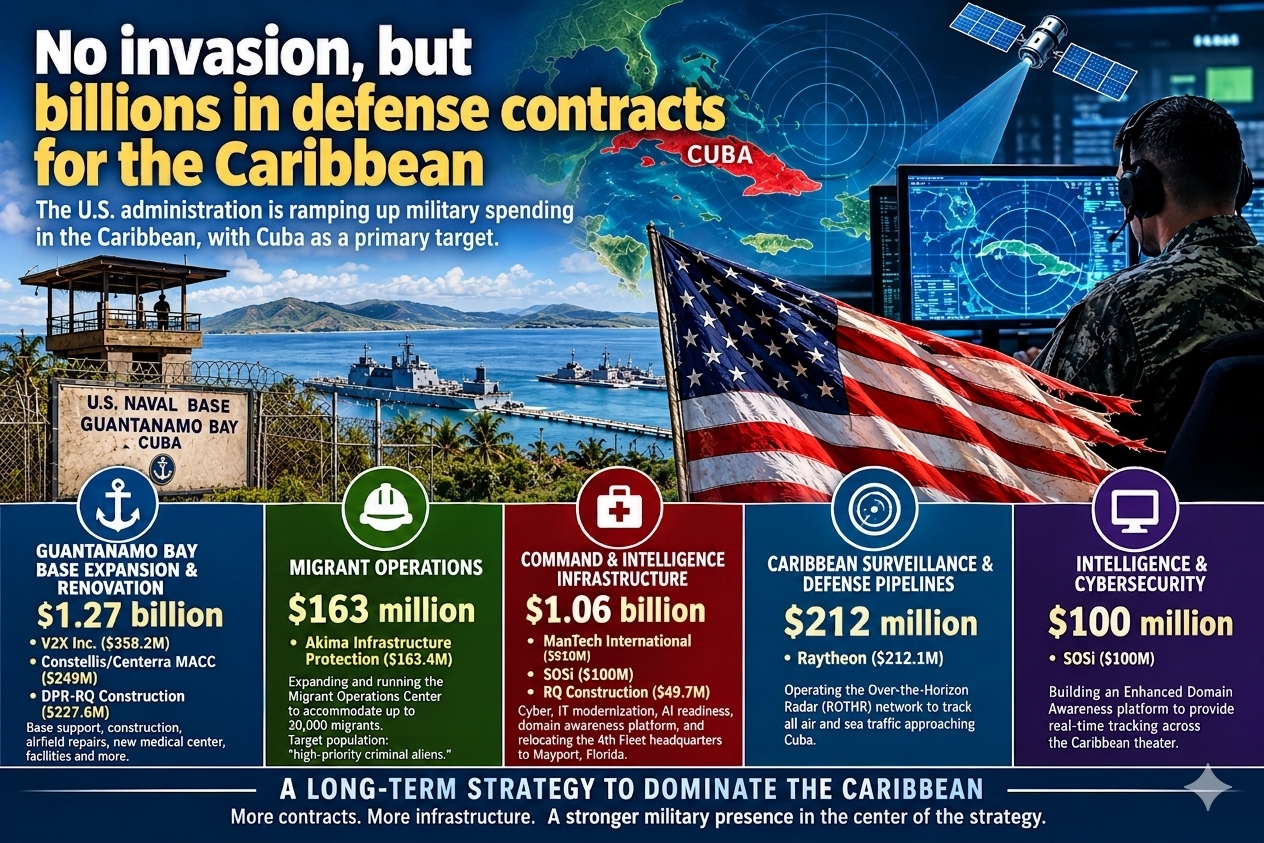
Indeed, no fighter jets were thundering over Havana and no amphibious assaults were underway. But the U.S. government has quietly unleashed more than $2.4 billion in defense contracts targeting Guantanamo Naval base infrastructure, Caribbean surveillance and artificial intelligence-driven intelligence networks, according to Fed-Spend.com.
Cuba, which the Trump administration describes as an “unusual and extraordinary threat” to U.S. national security, is a primary target of the spending surge, which spans 9 years from 2024 to 2032.
Active defense contracts include:
$1.27 billion for expansion and renovation of Guantanamo Bay Naval Base
- V2X Inc. ($358.2 million): Manages day-to-day base support and facilities operations through 2032.
- Constellis/Centerra MACC ($249 million): Multi-contractor award covering ongoing base construction, airfield repairs and renovations. Constellis has completed more than $165 million in work at GITMO since 2015 and has more than 140 personnel on the base, according to Fed-Spend.com. The company was formerly known as Academi, and before that, Blackwater.
- DPR-RQ Construction ($227.6 million): Building a state-of-the-art Ambulatory Care Center and Dental Clinic complete with trauma care and a helipad. This is the single largest GITMO contract. The contractor is replacing the Naval Hospital built in 1954. “You do not spend $228 million replacing a hospital at a base you plan to close,” according to Fed-Spend.com. “And the inclusion of trauma care, a helipad, and force protection features suggests a facility designed for significantly higher patient volumes and potential combat casualties.”
$163 million for Migrant Operations
- Akima Infrastructure Protection ($163.4 million): Expanding and running the Migrant Operations Center to accommodate up to 30,000 migrants. Target population: “high-priority criminal aliens.”
$1.06 billion for SOUTHCOM Command & Intelligence Infrastructure
- ManTech International ($910 million): Delivering comprehensive cyber, IT modernization, and AI readiness services. “The single largest contract supporting Cuba-area operations,” Fed-Spend reports. (See “Rising U.S.-Cuba tensions as Pentagon prepares digital battlefield“).
- SOSi ($100 million): Building an Enhanced Domain Awareness platform to provide real-time tracking across the Caribbean theater. This contract was awarded in February, a month before President Donald Trump told reporters, “I can do anything I want” with Cuba.
- RQ Construction ($49.7 million): Relocating and consolidating the U.S. 4th Fleet headquarters to Mayport, Florida. “Upgrades include HVAC, audiovisual equipment, and infrastructure improvements,” Fed-Spend.com reports. “You renovate and consolidate a fleet headquarters when you expect to use it more, not less.”
$212 million for Caribbean Surveillance & Defense Pipelines
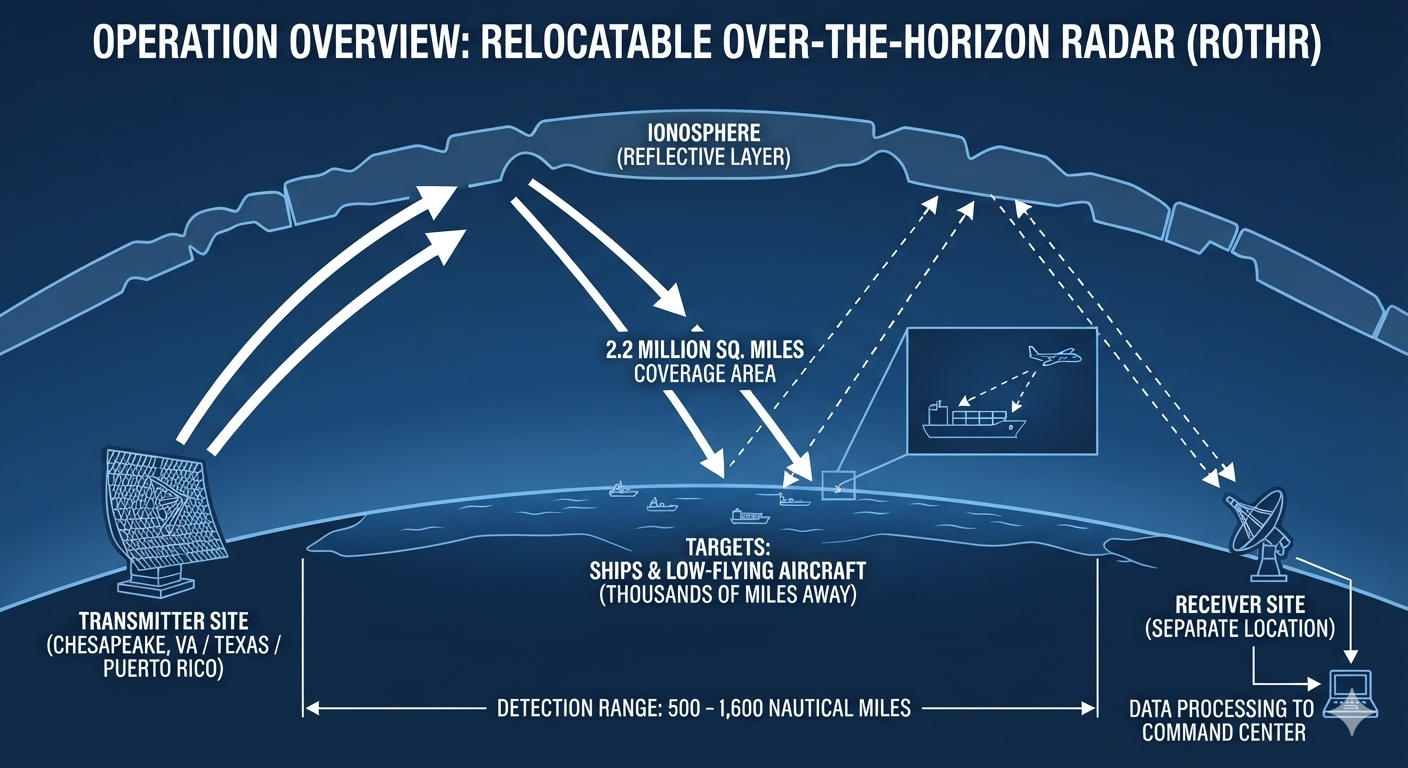
- Raytheon ($212.1 million): Operating the Over-the-Horizon Radar (ROTHR) network tracking all air and sea traffic approaching Cuba. “The ROTHR system uses high-frequency skywave radar bounced off the ionosphere to detect aircraft and vessels at ranges of 500 to 1,600 nautical miles – covering the entire Caribbean basin from fixed sites,” Fed-Spend.com reports. “This is the system tracking every aircraft and vessel approaching Cuba. It also serves as the primary sensor for Joint Interagency Task Force South (JIATF South), which coordinates multinational counter-narcotics operations.”
No matter what the Trump administration decides to do about Cuba, Fed-Spend.com expects the U.S. military to continue pouring money into Caribbean operations.
“SOUTHCOM’s $910M IT modernization and $100M domain awareness platform are multi-year investments that will continue. Raytheon’s ROTHR radar runs through 2031. V2X operates GTMO through 2032. The infrastructure is being built for sustained Caribbean operations over the next decade.”
The spending surge is tied to Trump’s version of the Monroe Doctrine, dubbed the Donroe Doctrine, outlined in the U.S. National Security Strategy. It seeks to dominate the hemisphere, aggressively shut out such rivals as Russia and China, and prioritize “America First” goals.
SOSi’s Enhanced Domain Awareness platform operates as a digital nervous system, putting radar data, satellite feeds and live ship-tracking onto a real-time command screen.
Feeding into this screen is Raytheon’s ROTHR network, operating from fixed sites in Virginia, Texas and Puerto Rico. It allows the military to track every aircraft and vessel across 2.2 million square miles.
ManTech International adds artificial intelligence to the networks, allowing automated algorithms to continuously scan the Caribbean, flagging suspicious behavior.
Not included in the $2.4 billion surge is a $2.2 billion intelligence contract awarded to Huntington Ingalls Industries, or HII, in August.
“This award is an incredible opportunity and goes right to the heart of what SOUTHCOM needs — clearer visibility, faster decision making, and the ability to stay ahead of rapidly changing threats,” HII executive Andy Green said in a statement on Aug. 11. “Our team understands the complexity of this region, and we’re proud to support the command with solutions that help protect U.S. interests and strengthen security across the hemisphere.”
HII specializes in unmanned systems and network signals intelligence. Under the contract, the firm will provide monitoring capabilities to detect, track and intercept illicit activities.
Contract documents don’t describe how this could apply to Cuba. I think it’s reasonable to speculate that if a sanctioned fuel tanker or supply ship falsified its transponder logs to try to slip into Havana, HII technology could flag it for interception.
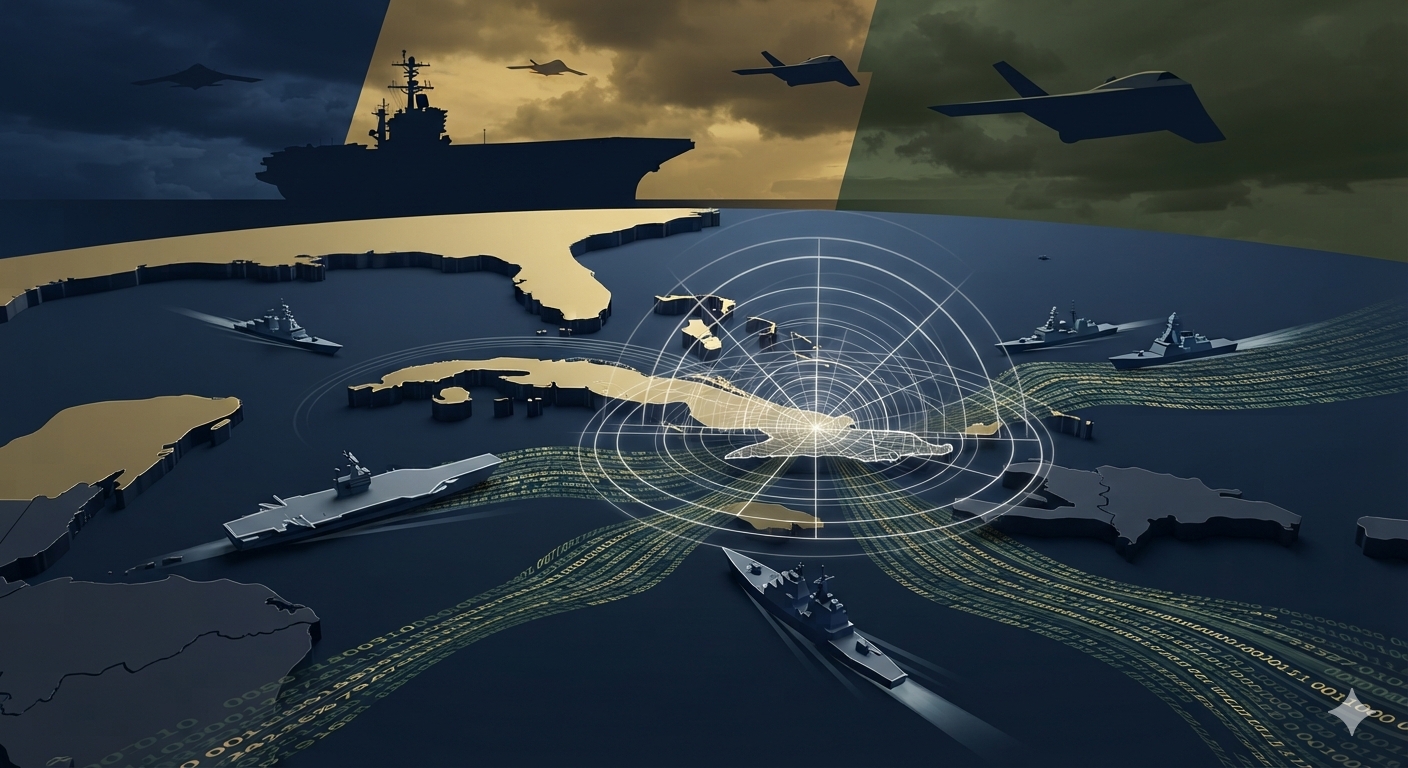
My guess is that the firm would also give SOUTHCOM the ability to monitor the Cuban government’s internal communications. So if Cuban authorities tried to shut down the internet during a rise in civil unrest, the U.S. could potentially bypass any communication blackouts.
Interestingly, if there were a sudden regime collapse in Cuba, the U.S. military would not need to wait for Congress to pass an emergency budget. HII’s $2.2 billion contract allows the firm and allied forces to immediately scale up reconnaissance flights, deploy unmanned surface fleets and manage tactical security realignments overnight.
On Sept. 26, Trump downplayed the likelihood of a U.S. military intervention in Cuba.
“I would say that Cuba and us will make a deal,” he said. “I don’t think we’ll need the military.”
Trump has delegated Cuba operations to Secretary of State Marco Rubio.
At the White House on Wednesday, the president praised Rubio.
“Wait until you see what he does with Cuba,” Trump said.
Gemini, Google’s AI tool, rates this article as accurate, but notes that the author is speculating when discussing specifically how the spending surge may impact Cuba. See fact check.