

Not long after taking office, Donald Trump gutted the U.S. Agency for International Development, calling it “incompetent and corrupt.” More than 80% of USAID programs were cancelled. The agency ceased operations and the State Department took over its remaining programs.
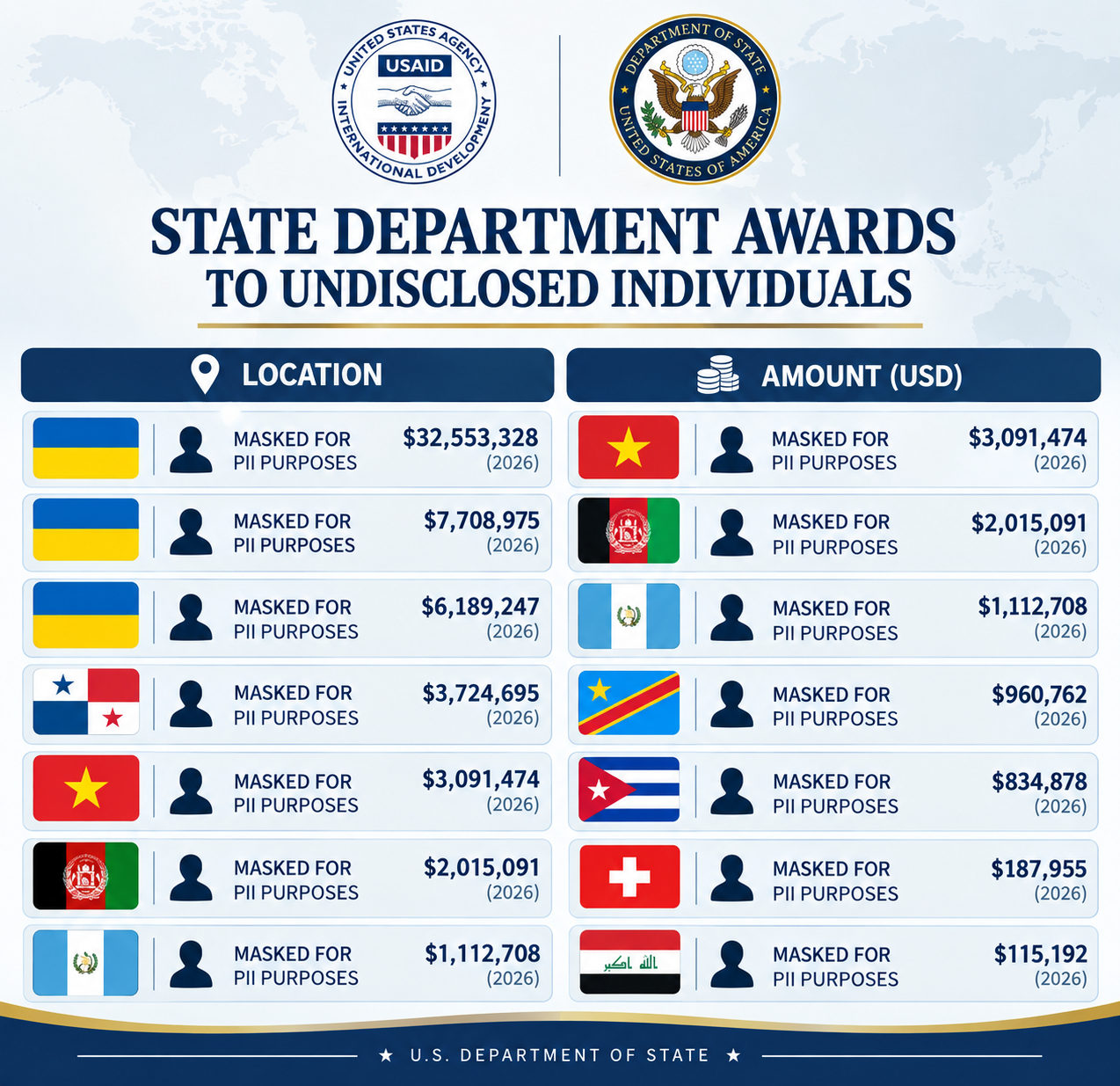
On Sept. 15, the State Department reported spending $58,494,305 in legacy USAID funds in Ukraine, Afghanistan, Cuba and six other countries. What’s peculiar is that the money is going to less than a dozen people, all of them unidentified, USASpending.gov records show.
These unusual State Department awards include a whopping $32,553,328 for a single unidentified individual in Ukraine. Transaction descriptions are “masked for PII purposes.” PII stands for “personally identifiable information.” Revealing that, the government argues, would violate privacy laws.
I don’t know why the $58 million money trail is so muddy. I suspect they got sloppy when Elon Musk and the Department of Government Efficiency, or DOGE, swept in to dismantle USAID.
Before DOGE arrived, the State Department routinely gave undisclosed individuals modest awards, a few thousand dollars each for travel, training, conferences and other purposes. The size of such awards has soared during Trump’s second term, spending records show. See graphic below.

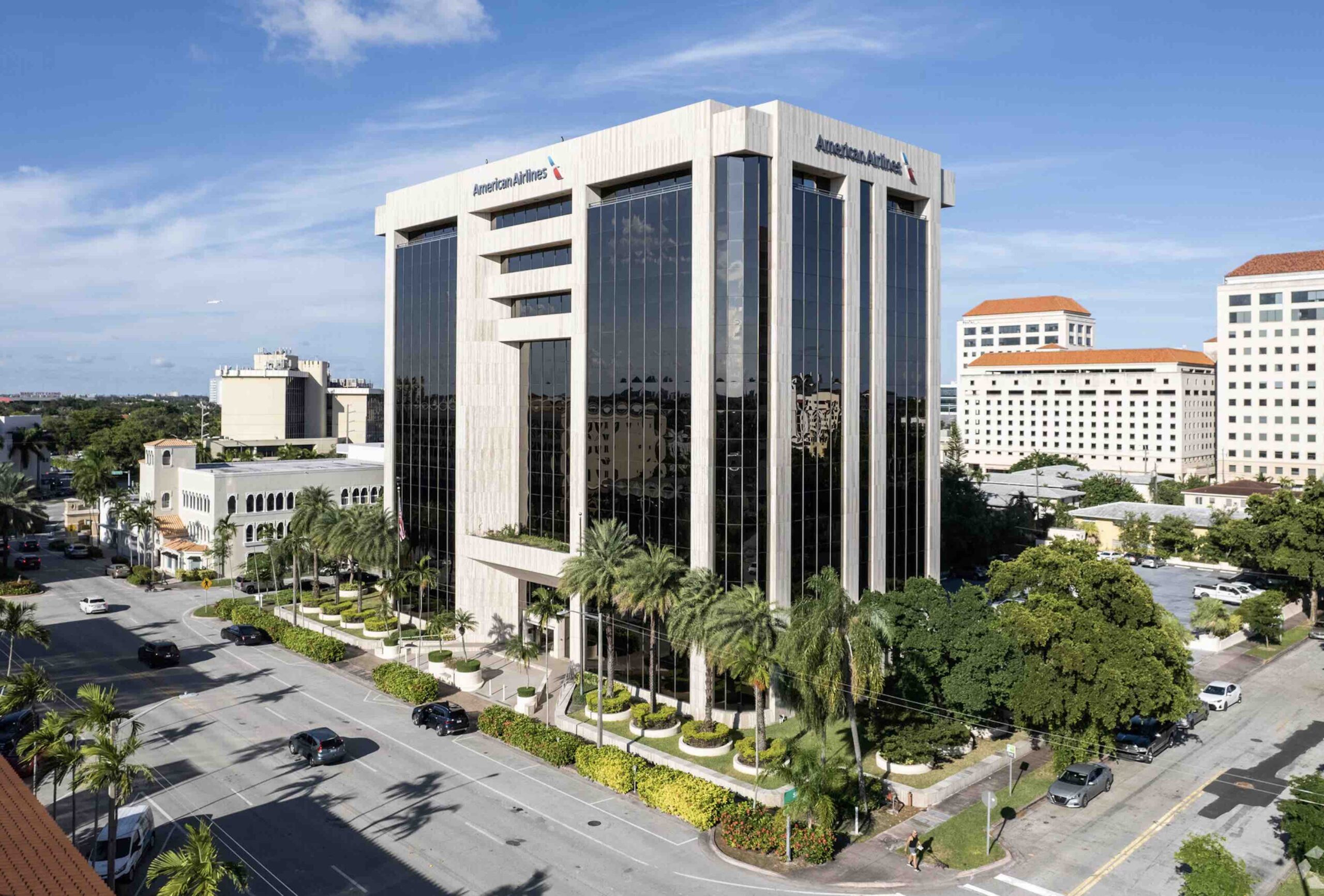
The Cuba award is worth $834,878. Records show the recipient’s address only as Miami, FL 33134-3059. That corresponds to a 10-story commercial office building at 901 Ponce de Leon Blvd. in Coral Gables, Florida. Among the many businesses and organizations located at that address is the Foundation for Human Rights in Cuba.
On Sept. 27, 2023, USAID awarded the foundation $3 million for its “Cuba Democracy Program: Independent Media and Free Flow of Information.” The agency paid out $2,165,122.20 before disbanding, records show. The remaining amount due was $834,877.80, which corresponds with the mysterious Cuba award.
No doubt, the foundation would welcome the funds given its increasingly important role in the Trump administration’s “maximum pressure” and information warfare campaign against Cuba.
The foundation’s 2025 tax records shed light on some of the organization’s activities. Its spending includes:
- $493,914 from the National Endowment for Democracy to run its Cuban Repressors program, a sophisticated database of photographs, names, ranks and other information of regime officials. It shares the data with the State Department to enforce travel and financial sanctions against Cuban officials. “The data base is a deterrent because their names and information feeds into the Department of State for imposition of individual sanctions. These tools are matched with name and shame campaigns to Cuba exposing the repressors in flyers and digital communications,” a program description states.
- $255,707 from USAID “to expose and dismantle the Cuban regime’s exploitation of medical professionals deployed abroad in public health. The program combines evidence-gathering, advocacy, and capacity-building: documenting testimonies from exiled and current medical workers, developing digital platforms like the New Observatory of Cuban Labor Export Programs (OCLEP), and partnering with activist networks, academics, and civil society to reveal falsified health statistics and human rights violations,” records show.
- $540,270 from the State Department’s Bureau of Western Hemisphere Affairs for a program involving democratic governance and leadership. Participants promote a “new narrative on change” and a vision that “a better Cuba is possible.”
The foundation also reported spending $710,490 for “aid and support, cash, equipment, pre-paid minutes, travel and other items sent to Cuba.” No government agencies are tied to the funds, which likely came from private contributors. The FHRC reported a robust $2,143,795 in private donations in 2024 and 2025.
The FHRC’s stated mission is “to promote a nonviolent transition to a free and democratic Cuba with zero tolerance to human rights abuses. FHRC feels a profound responsibility to support and empower Cuban civil society in its efforts to bring freedom and democracy to their country.”
The organization was founded in 1992. The group’s executives, including Board President Jose Antonio Costa and Vice President Clara Maria Del Valle, operated with zero pay and minimal staff for many years. Back then, the volunteer-driven foundation was the humanitarian branch of the Cuban American National Foundation, or CANF, then a political lobbying powerhouse. Since then, the dynamic has flipped. The CANF is now subordinate to the FHRC, which outgrew its creator and became a highly specialized multimillion-dollar federal contractor.
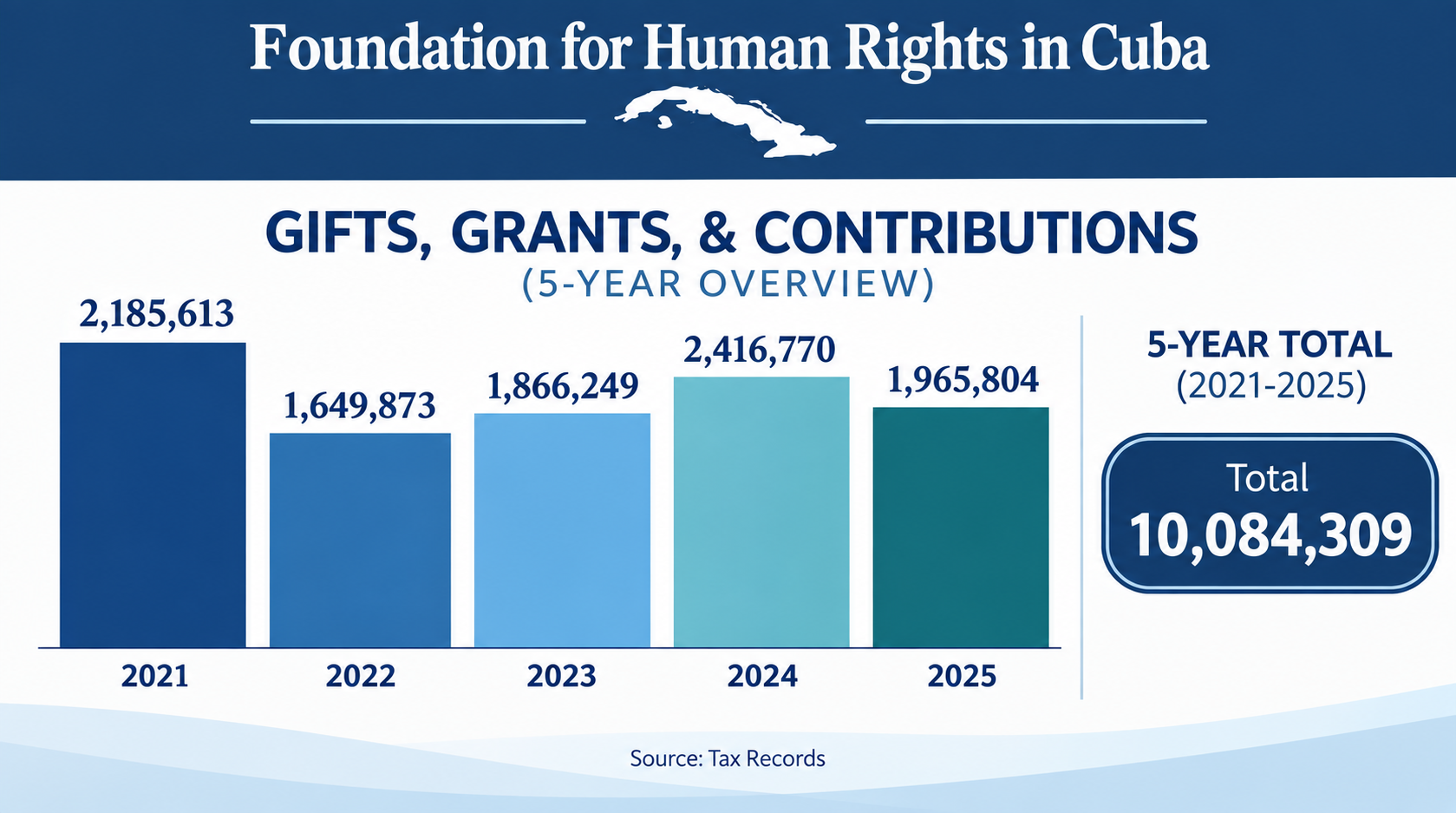
The foundation obtained $10,084,309 in government grants and private contributions from 2021 to 2025, allowing it to recruit top experts and researchers.
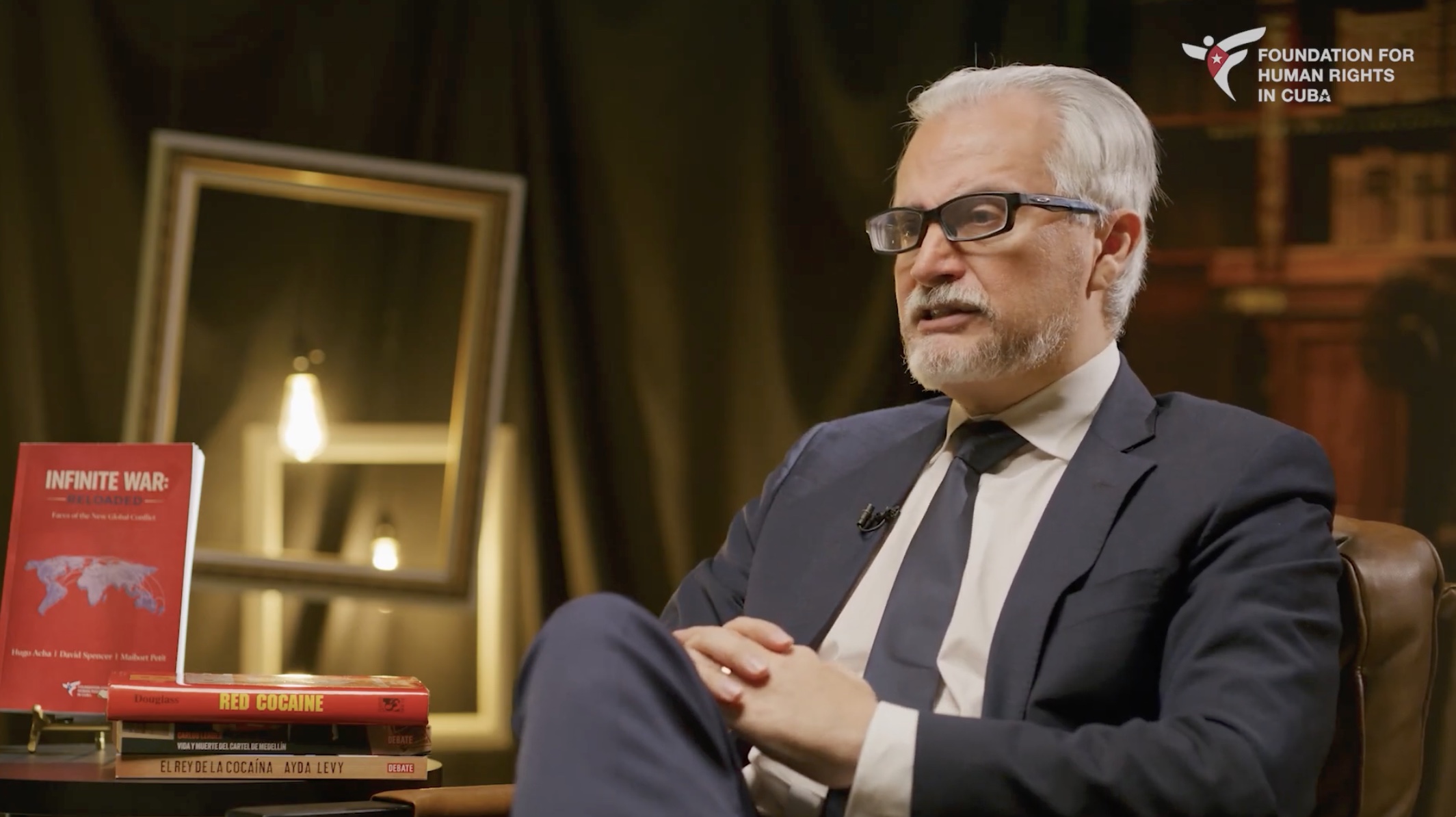
By 2025, the organization had 14 full-time employees and a payroll of more than $1 million. The foundation’s highest-paid employee is Hugo Acha, an international lawyer and specialist in counterterrorism and transnational organized crime. Tax records listed his salary as $157,500 in 2025.
Acha is the group’s director of research and outreach. He oversees the Repressors database and analyzes the Havana-Caracas Axis, documenting overlap between the Cuban and Venezuelan governments.
In addition, Acha is a senior research fellow for transnational organized crime at the Center for a Secure Free Society, a national security think tank. See “Combatting Cuban Transnational Organized Crime.” He is also an instructor for U.S. special forces, and teaches strategic dynamics, intelligence and regional security. See video containing information about his work.
The foundation’s audits consistently return zero weaknesses, zero compliance violations and no questioned costs. But the group ran into financial trouble in 2025, around the time Trump began ripping apart USAID and cancelling programs.
FHRC president Jose Antonio Costa loaned the group $50,000 to keep it afloat. Secretary of State Marco Rubio – who was also USAID’s acting administrator – stepped in and revived selected Cuba programs.
Since then, the Trump administration has made clear it supports hardline democracy-promotion and anti-regime initiatives, boosting the FHRC and other groups.
If indeed the mysterious $834,878 award is part of the foundation’s $3 million “Cuba Democracy Program: Independent Media and Free Flow of Information,” then it stands to reason that the program has something to do with the U.S. government campaign against Cuban doctors working abroad.
Spending records now link the $834,878 award to the State Department’s Bureau of Global Health Security and Diplomacy, or GHSD. In March, Politico reported that the bureau, established in 2023, was campaigning to “effectively eliminate” Cuba’s international medical missions, a major source of revenue for the socialist government.
Politico cited an internal State Department memo outlining plans to convince 16 Western Hemisphere countries to dump an estimated 19,000 Cuban health care professionals deployed abroad. Toward that end, the FHRC has been campaigning against the medical program. Its stated goal: “To protect Cuban medical workers’ rights, counter authoritarian disinformation, and ensure international accountability while aligning with U.S. security and human rights priorities.”
The NED funds the foundation’s Cuban Repressors program. Its goal is to collect open-source evidence, including photos, confirmed identities and witness statements, that the U.S. government can use to sanction foreign officials. Such evidence is required under the Global Magnitsky Human Rights Accountability Act, which authorizes the president to impose economic sanctions and visa restrictions on foreign individuals and entities worldwide, and Section 7031(c), which requires the Secretary of State to bar foreign government officials and their immediate family members from entering the U.S. if there is credible evidence of their involvement in significant corruption or human rights violations.
Similar programs around the world include:
- The Sentry, which tracks the financial networks of warlords and human rights abusers in Africa.
- CASLA Institute, which is like the FHRC but focuses on Venezuela.
- C4ADS or the Center for Advanced Defense Studies, which tracks illicit networks, asset movements of sanctioned oligarchs and forced labor supply chains, and
- Human Rights First, which manages a Magnitsky sanctions coalition.
The Cuban government has characterized the FHRC as a U.S. government front organization aimed at subverting national sovereignty.
“If you try, as an agent of a foreign government, to mobilize people against the government, you’re committing a crime in the law,” Cuba’s Deputy Foreign Minister Carlos Fernández de Cossío told PBS News Hour on Sept. 16. “It’s not different from the laws that you have in the United States.”
During the interview with Amna Nawaz, Fernández de Cossío said the U.S. is trying to “take control of Cuba.”
“They want to take over Cuba,” he said. “That is quite an ambitious goal that certainly is unacceptable for Cuba.”
U.S. strategy, he said, is not aimed at encouraging democracy. Instead, it’s a criminal campaign aimed at forcing government collapse.
“We live in a world of intimidation in which the United States, for the first time in history, has the capacity to intimidate each and every government around the world and restrict their sovereign right to trade with whomever they want,” he said.
Gemini, Google’s AI tool, rates this article as “accurate,” although it notes that the author’s best guess as to the fate of the Cuba award hasn’t been verified. See fact check.