
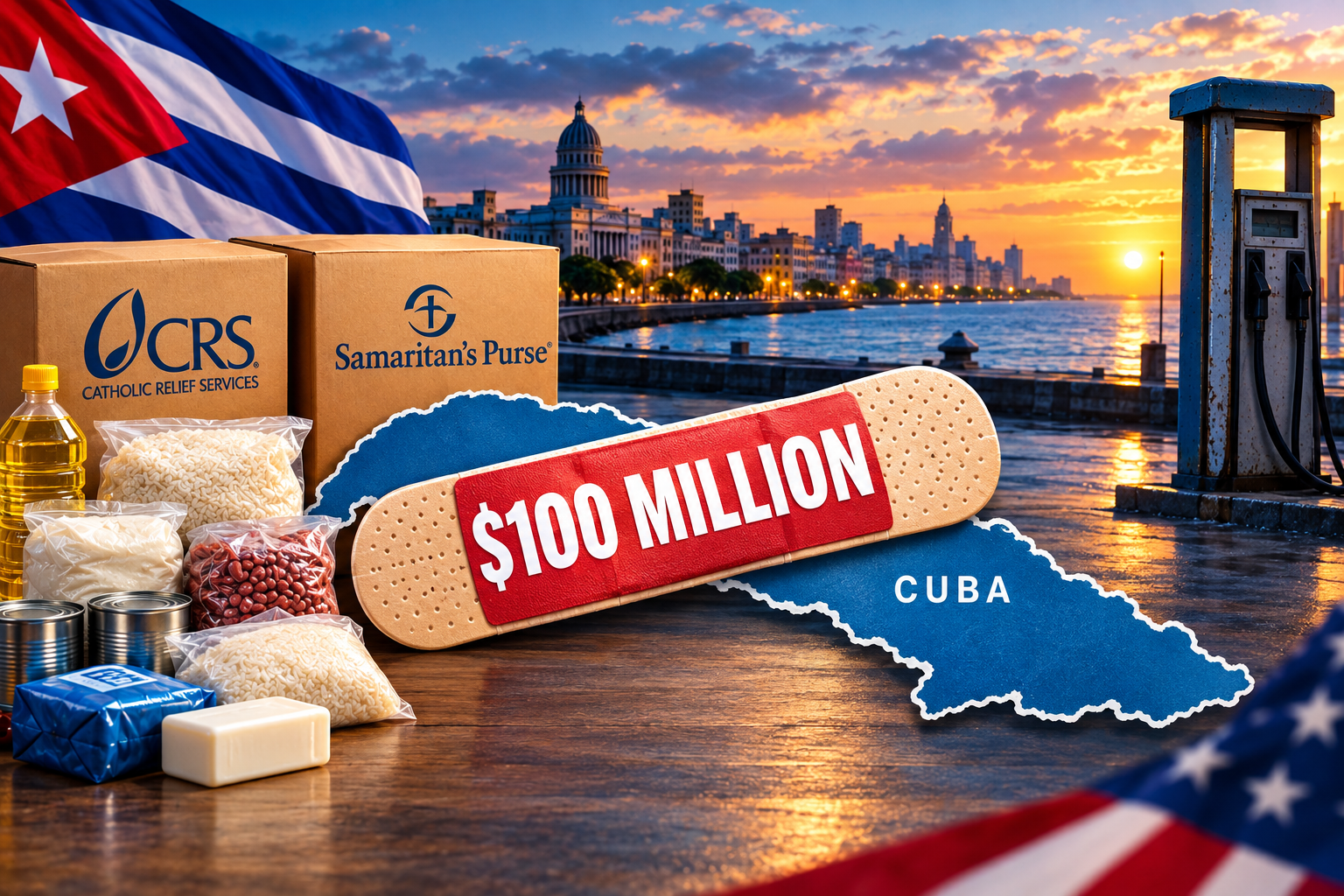
The U.S. government is spending $100 million to send emergency aid to Cuba while ramping up efforts to strangle the island’s economy.
The State Department awarded Catholic Relief Services $60 million to send boxes of food and supplies to around 200,000 households.
Samaritan’s Purse received a $40 million State Department grant. It hasn’t announced a distribution plan. If it were to assemble aid boxes similar to CRS’s, it would have enough money for around 100,000 aid packages, according to an AI analysis which took into account that group’s higher overhead costs.
The purpose of the Samaritan’s Purse grant is “to provide emergency humanitarian assistance in order to alleviate critical food insecurity, health and WASH (Water, Sanitation and Hygiene) needs of vulnerable populations in Cuba and mitigate the impacts of extreme fuel shortages.”
The U.S. government caused the fuel crisis after cutting off most oil shipments to Cuba earlier this year. Now it’s providing aid boxes that are likely to be consumed in as little as three to five days in crowded households.
CRS aid boxes contain such items as rice, beans, flour, sugar, tuna and cooking oil, along with soap, toothpaste and feminine hygiene products.
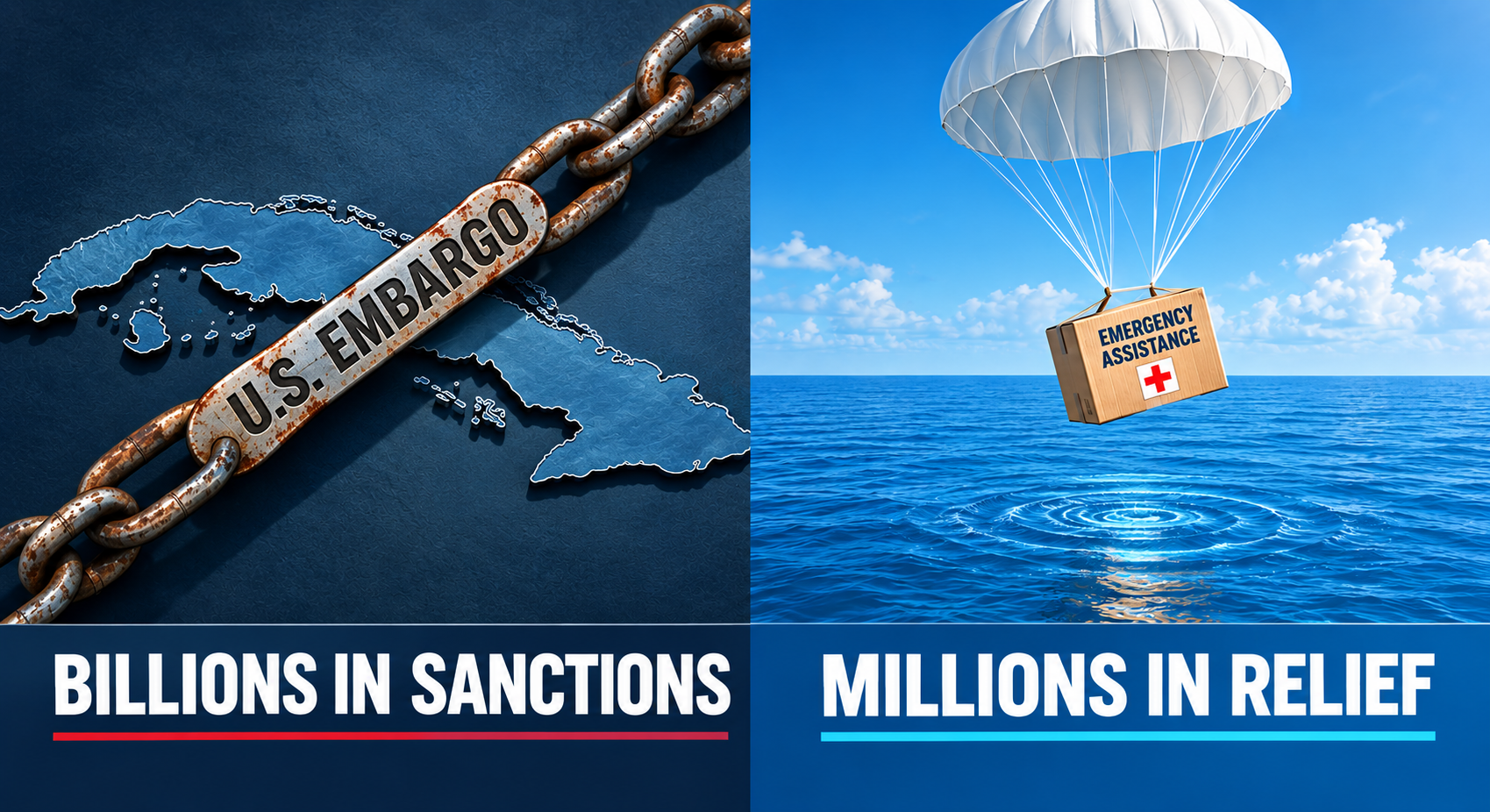
The aid packages may be a lifesaver for an elderly couple trying to endure the latest blackout, but they will do little to combat the U.S. embargo, the toughest, longest-lasting economic sanctions ever imposed on any nation in modern history.
Earlier this month, Cuban Foreign Minister Bruno Rodríguez told the United Nations that U.S. sanctions caused $8.083 billion in damages over a 12-month period. Cuban officials estimate the accumulated damages to be more than $3.89 trillion when adjusted against the price of gold.
Against that, $100 million is a microscopic drop in the bucket.
The CRS aid targets vulnerable groups, including elderly people living alone, pregnant or breastfeeding mothers who face health risks, families with children under the age of 5, individuals with disabilities and, under a separate allocation, people who need such essentials as mattresses and blankets.
CRS is partnering with Caritas Cuba to channel supplies through parish networks. Samaritan’s Purse will likely use Protestant and evangelical networks.
According to the AI analysis, CRS will spend $246.84 and $276.98 for each aid box, including the contents, transportation costs and local tracking. Samaritan’s Purse packages are projected to cost around $400 each because that organization has higher overhead.
CRS revenue totaled $1.2 billion in 2025. U.S. government grants made up 46% of its funding. Audits show that 92% of expenses are spent on direct aid. Charity Watch gives it a “top-rated A+ grade.”
The organization’s president and CEO is Sean Callahan, whose annual salary is $602,888, not including $87,039 in benefits.
Samaritan’s Purse revenue reached $1.84 billion in 2024; 2025 revenue has not yet been reported. From 77% to 85% of expenses are spent on direct aid. The organization has an 4-star Charity Watch rating. Ministry Watch slapped it with a “Withhold Giving” label because it withdrew from the Evangelical Council for Financial Accountability in 2025.
The group’s president and CEO is Franklin Graham, who commands a $945,493 annual salary, not including at least $250,000 from the Billy Graham Evangelistic Association.
On Aug. 28, Samaritan’s Purse rejected a $300 million State Department grant. Graham said the organization declined the money after “prayer and discussion.”
“Throughout my history leading Samaritan’s Purse, we have always relied on God, not government, for funding,” he said.
The Agency for International Development traditionally handled distribution of most U.S. humanitarian aid. But in 2025, Donald Trump disbanded USAID and directed $2 billion toward private, faith-based organizations.
Samaritan’s Purse typically includes evangelical messages with its aid packages, but it is unlikely to follow that practice in Cuba. Federal law bans grant recipients from including religious messages with aid packages.
Some 750,000 Cubans could benefit from the aid program, the AI analysis shows. That is nearly 8% of the country’s estimated 9,436,440 people.
Secretary of State Marco Rubio blames the Cuban government, not U.S. sanctions, for the country’s economic troubles. He said his goal is to choke the Cuban regime while providing relief to people who are most vulnerable.
Cuban officials question the sincerity of the humanitarian aid. They believe the U.S. continues trying to use hunger as a weapon. They point to an April 6, 1960, memo by Lester D. Mallory, then the U.S. Deputy Assistant Secretary of State for Inter-American Affairs. He wrote:
“The majority of Cuban people support Castro… The only foreseeable means of alienating internal support is through disenchantment and disaffection based on economic dissatisfaction and hardship… Every possible means should be undertaken promptly to weaken the economic life of Cuba… to decrease monetary and real wages, to bring about hunger, desperation and overthrow of government.”
In May 2026, human rights experts at the United Nations Office of the High Commissioner for Human Rights condemned U.S. tactics and warned that blocking oil shipments triggered “energy starvation.”
U.S. officials claim to target only the Cuban regime, UN rapporteurs said, but their restrictions intentionally “cripple the functioning of essential services required for a dignified life.”
Google’s AI tool, Gemini, rates this article as accurate, although it notes that the precise number of people who will benefit and the cost per delivery of each aid box have not been verified. See fact check.